 Every Munro
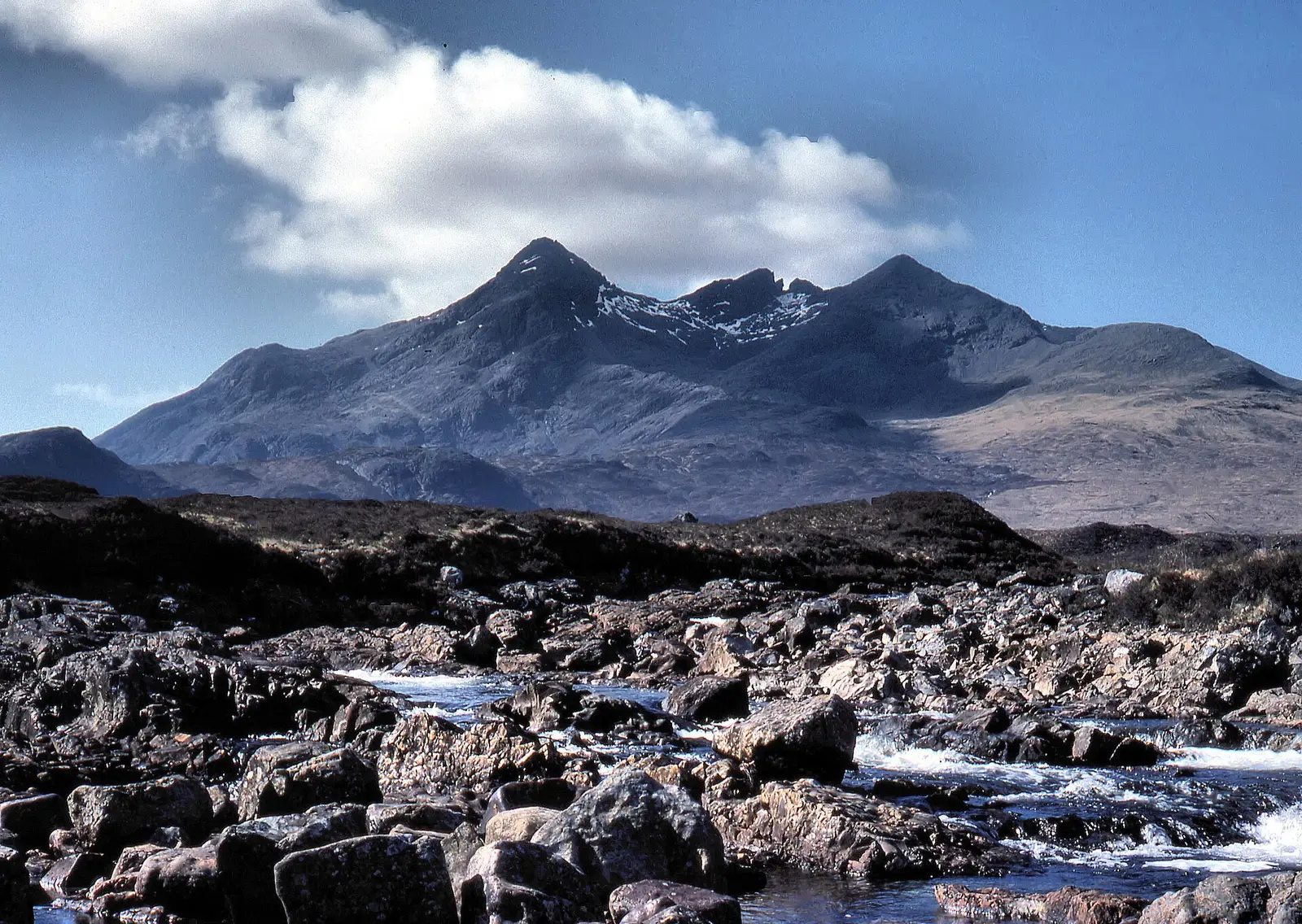

Cuillin ridge
The Cuillin ridge on Skye is a rock-climbing and mountaineering traverse, not a walk: a Skye mountain guide quoted in the British Mountaineering Council's guide calls it "definitely climbing not walking". It needs hands from end to end, with rope work and abseils, and it is not a first Munro or a route for anyone who has not climbed. Of Skye's 12 Munros, 11 are Cuillin peaks; the other is Bla Bheinn.
How hard is the Cuillin ridge?
Not a walk. It is scrambling and rock climbing from end to end. The British Mountaineering Council's guide says that to tackle the ridge you need to be very comfortable moving over grade 3 ground and handy with a rope, able to set up a retrievable abseil. Route finding is tricky even in good visibility, and compasses are unreliable on the magnetic rock. This site gives no line and no time for the traverse. If you have not climbed, do not try it: go with a qualified mountain guide.
The BMC's guide describes about 12 km of crest from Gars-bheinn in the south to Sgurr nan Gillean in the north, crossing plenty of grade 3 and harder scrambling and three Severe rock-climbing pitches that can be avoided. It quotes Mike Lates, a mountain guide on Skye since 1995: about 4,000 m of ascent and descent would make a very big mountain walk, "but the Traverse is definitely climbing not walking".
The guide names three sections where the route finding and technical difficulty intensify for hours: the climb out of the TD Gap to the abseil from the Inaccessible Pinnacle; the tops of Sgurr a' Mhadaidh and Bidean Druim nan Ramh, with two abseils; and the Basteir Tooth and Am Basteir before Sgurr nan Gillean. It says fewer than 10% of parties who set off to attempt the ridge succeed.
Mountaineering Scotland describes grade 3 as advanced scrambling: moves on steep rock in very exposed situations, where some people may prefer a rope, occasional moves of rock-climbing standard, and an abseil useful in retreat. It also warns that scrambling can be the most dangerous of all mountaineering activities.
| Where | The Black Cuillin, Isle of Skye, from Gars-bheinn in the south to Sgurr nan Gillean in the north |
|---|---|
| Munros | 11, all named below |
| Ground | Grade 3 and harder scrambling, three avoidable Severe climbing pitches, and abseils (BMC) |
| Length | About 12 km along the crest, with about 4,000 m of ascent and descent (BMC) |
| Success | Fewer than 1 in 10 parties who set off complete it (BMC) |
| Under snow | In a different league (BMC) |
| Maps | OS Explorer 411, OS Landranger 32 |
Heights, Munro Tops and maps are from this site's data. Grades, and distances and times credited to others, are theirs, read on 19 November 2026.
Which Munros are on the Cuillin ridge?
11, as the stalking table for the islands lists them under the Cuillin: Sgurr nan Gillean (966 m), Am Basteir (934 m), Bruach na Frithe (959 m), Sgurr a' Mhadaidh (918 m), Sgurr a' Ghreadaidh (972 m), Sgurr na Banachdich (965 m), Sgurr Dearg - Inaccessible Pinnacle (986 m), Sgurr Mhic Choinnich (948 m), Sgurr Alasdair (992 m), Sgurr Dubh Mor (944 m) and Sgurr nan Eag (926 m).
Sgurr Dearg - Inaccessible Pinnacle is the one whose summit is a graded rock climb: its top is the Inaccessible Pinnacle, with an abseil to come down. The Inaccessible Pinnacle has its story. Sgurr Alasdair is the highest of the twelve Skye Munros.
Which Cuillin Munros this site shows a route for
This site maps a route to 9 of the 11, each to one summit from the glen and back the same way, not along the ridge. 8 of those routes are flagged because the top needs hands, and each hill page says so first: Sgurr nan Gillean, Am Basteir, Sgurr a' Mhadaidh, Sgurr a' Ghreadaidh, Sgurr na Banachdich, Sgurr Dearg - Inaccessible Pinnacle, Sgurr Mhic Choinnich and Sgurr Alasdair. Bruach na Frithe is the one not flagged for scrambling on this site's route, and it is still a steep mountain day in the Cuillin.
It holds back 2: Sgurr Dubh Mor and Sgurr nan Eag. For both, the path on the map stops at Loch Coir' a' Ghrunnda, and the way on to the summit is scrambling with no path, so no line is drawn and no time is given. Their pages say where the usual way goes and why it is held back.
The traverse itself is not one of this site's routes. This site has not mapped it, so we give no line and no time of our own for it.
Why many people go with a mountain guide
The ridge needs sure movement on exposed grade 3 rock, rope work, abseils and navigation where a compass cannot be trusted. The BMC's guide advises sampling short sections first, studying descriptions and photographs, finding a trusted partner of the same ability, and waiting for a settled two-day weather window, and still says fewer than one party in ten who set off succeeds.
Even single Cuillin summits are serious. The Scottish Mountaineering Club's description of Sgurr nan Gillean, published by Mountaineering Scotland, says the easiest of its three ridges, the so-called Tourist Route, is not a route for tourists, or for anyone without a head for heights and some scrambling ability, and that many opt for a professional guide or a friend with rock-climbing skills and a rope for it and Am Basteir.
If you have not scrambled before, do not start here: go with a qualified guide or instructor. The Association of Mountaineering Instructors and British Mountain Guides list their members.
In an emergency dial 999, ask for the police, then for mountain rescue. Scottish Mountain Rescue explains what to tell them.
Parking, stalking and winter
Parking. This site's routes to single Cuillin summits start from Sligachan, Glen Brittle and the Fairy Pools car park. We have not confirmed parking charges at these starts, so check the signs.
Stalking. The stalking table for the islands, updated on 20 December 2023, lists the Cuillin Munros, with the John Muir Trust's land east of Glen Sligachan given as having no stalking issues.
Winter. The BMC's guide says that under a blanket of snow the ridge is in a different league. The Scottish Avalanche Information Service forecasts for six areas of the Highlands, and this is not one of them, so judge the snow for yourself.
Sources
Every page below was opened and read on 19 November 2026. Distances, climbs and times for our own routes come from this site's route data, not from these pages.
- British Mountaineering Council: how to scramble the Cuillin Ridge: the ground, the grades, the skills, the length and ascent, the three hard sections, the navigation, the success rate, snow and the advice to prepare
- Mountaineering Scotland: scrambling: what grade 3 means, and the danger of scrambling
- Mountaineering Scotland: Scotland's best walks, Sgurr nan Gillean (from The Munros, SMC): the Tourist Route on Sgurr nan Gillean, and that many go with a guide
- Heading for the Scottish Hills: Islands stalking table, updated 20 December 2023: which Munros are the Cuillin, and stalking
- Scottish Avalanche Information Service: the six areas it forecasts for: the areas it forecasts for, none of them on Skye
- British Mountain Guides: find a guide: where to find a qualified mountain guide
- Association of Mountaineering Instructors: find an instructor: where to find a qualified instructor
- Scottish Mountain Rescue: mountain safety advice: what to do in an emergency
Questions
What is the Cuillin ridge?
The main ridge of the Black Cuillin on Skye, about 12 km of rocky crest from Gars-bheinn to Sgurr nan Gillean with 11 Munros on it. Traversing it is a rock-climbing and mountaineering route, not a walk.
Can you walk the Cuillin ridge?
No. The British Mountaineering Council's guide quotes a Skye mountain guide calling the traverse climbing, not walking: it needs sure movement on grade 3 and harder rock, rope work and abseils. If you are not an experienced climber, go with a qualified mountain guide.
How many Munros are on the Cuillin ridge?
11: Sgurr nan Gillean, Am Basteir, Bruach na Frithe, Sgurr a' Mhadaidh, Sgurr a' Ghreadaidh, Sgurr na Banachdich, Sgurr Dearg - Inaccessible Pinnacle, Sgurr Mhic Choinnich, Sgurr Alasdair, Sgurr Dubh Mor and Sgurr nan Eag. Skye's twelfth Munro, Bla Bheinn, stands apart from the ridge.
Do you need a guide for the Cuillin ridge?
Unless you are an experienced climber who can move confidently on exposed grade 3 rock, use a rope and set up an abseil, yes. The British Mountain Guides and the Association of Mountaineering Instructors list qualified members.
How long does the Cuillin ridge take?
It is not timed like a walk. The British Mountaineering Council's guide says some climbers have the skills and fitness to complete it in one long day, but that for most it is a two-day climb, with a night out at the south end of the ridge, and fewer than one party in ten who set off succeeds.
Which is the easiest Munro in the Cuillin?
On this site's routes, Bruach na Frithe is the only Cuillin Munro whose route is not flagged for scrambling. It is still a steep, rough mountain day, and the peaks beside it need hands.
Next
- Munros for beginners Eight good first Munros, with the distance, climb and time for each.
- What is a Munro? How many there are, how high they have to be, and who Sir Hugh Munro was.
- How long does it take to climb Ben Nevis? The time to allow, the two routes, where to park and Ben Nevis in winter.
- Ben Lomond How long it takes, the tourist path against the Ptarmigan ridge, and the Rowardennan car park.
- Schiehallion The Braes of Foss car park, where the path ends and how long the walk takes.
- Ben Lawers The car park on the hill road, the walk over Beinn Ghlas and the nature reserve.
- Ben Chonzie The two places to park, Glen Lednock and Loch Turret, and the walk from each.
- Ben Vorlich (Loch Earn) Where to park at Ardvorlich, the walk from the loch, and Stuc a' Chroin next door.
- Beinn Eighe The two Munros, the round by Coire Mhic Fhearchair, and the nature reserve trails.
- An Teallach The two Munros from Dundonnell, and the pinnacle ridge that is a serious scramble.
- Liathach The two Munros above Glen Torridon, each on its own, and the pinnacles between.
- Beinn Alligin The two Munros, the great cleft of the Eag Dhubh, and the Horns of Alligin.
- Buachaille Etive Mor The walkers' way up by Coire na Tulaich, the full ridge, and the risk under snow.
- Buachaille Etive Beag Two Munros from one start on the A82, by a path to the col between them.
- The Five Sisters of Kintail The ridge above Glen Shiel, its three Munros, and the long one-way traverse.
- The Ring of Steall Four Mamores Munros above Glen Nevis, two narrow ridges and a wire bridge.
- The CMD Arete The scramble from Carn Mor Dearg to Ben Nevis: how hard, how long and the way off.
- Bla Bheinn Skye's walkers' Munro from Loch Slapin, the easy scrambling at the top, and Clach Glas.
- Beinn a' Ghlo Three Munros above Blair Atholl from one car park, and the long round of all three.
- Slioch The Munro above Loch Maree, by the long walk in from Incheril and Coire na Sleaghaich.
- The Tarmachan Ridge Meall nan Tarmachan from the Ben Lawers road, and the ridge beyond with its one short scramble.
- Lochnagar and the White Mounth Lochnagar from Glen Muick, the four other Munros of the plateau, and the five-Munro circuit.
- The Ben Lawers range Seven Munros north of Loch Tay, each on its own walk, and the long one-way traverse.
- Best hikes in Scotland Ten standout Munro walks, from Ben Lomond to Ben Hope.
- Munro bagging: how to start What it is, how people keep count, and how long a round takes.
- What to take up a Munro A kit list for summer and winter, and what to look for in each item.
- Munros by train and bus The stations and coach stops that put you at the foot of a Munro.
- A weekend of Munros Two-day plans from Glasgow, Edinburgh, Inverness and Aberdeen.
- The nearest Munro to England Ben Lomond, and how far it is from Carlisle, Newcastle and the cities further south.
- The Arrochar Alps The four Munros at the head of Loch Long, with the two places to start.
- Glencoe Munros Five walks in Scotland's most famous glen, and the ridges to leave for later.
- Cairngorms Munros Six walks into Britain's highest range, from the Aviemore and Braemar sides.
- Skye Munros The twelve on the island, from the walkable to the Inaccessible Pinnacle.
- The Inaccessible Pinnacle The story of the In Pinn, the only Munro that needs a rock climb.
- Torridon Munros Liathach, Beinn Eighe and Beinn Alligin, by the walkers' routes.
- Glen Lyon Munros The six Munros of Glen Lyon, from Invervar and Loch an Daimh, with the walk to each.
- Cairnwell Munros The three short walks from the top of the Cairnwell Pass at Glenshee.
- Glen Affric Munros All 16 of Glen Affric, Loch Mullardoch and Glen Strathfarrar, from Carn Eighe down.
- Corrour Munros Five Munros from a station with no road, and how to fit them round the trains.
- Mamores Munros All ten between Glen Nevis and Kinlochleven, with five walks and the full traverse.
- Kintail Munros All 23 of Kintail and Glen Shiel, from the Five Sisters to the Cluanie hills.
- Fannichs Munros The nine north of Loch Fannich, from Sgurr Mor down, with five walks.
- Fisherfield Munros The five remote Munros of the Great Wilderness, with An Teallach and Slioch.
- Munros in winter What changes under snow, the kit and skills you need, and where to learn them.
- The hardest Munros The climb, the scrambles and the long remote days, ranked from site data.
- The Aonach Eagach The Glencoe ridge, its two Munros, and why it is a scramble and not a walk.
Munros near: Glasgow, Edinburgh, Stirling, Perth, Dundee, Aberdeen, Aviemore, Inverness, Fort William, Pitlochry, Oban, Ullapool, Braemar, Killin, Crianlarich, Tyndrum, Kinlochleven